

War Is a Human Problem—Why Aren’t We Teaching It That Way?
Hegseth is remaking the curriculum at our service academies.

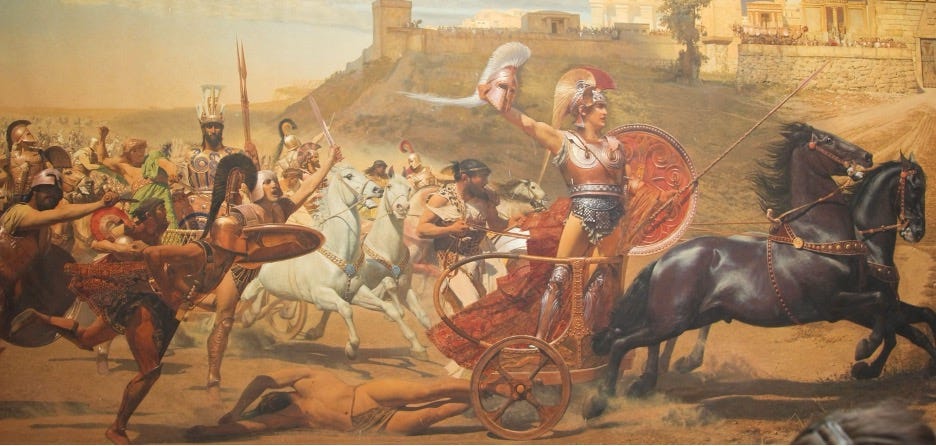
Achilles and Hector — Alan Carter
“Where there is no room for reflection, there is none either for justice or prudence.”
—The Iliad, or the Poem of Force by Simone Weil
Secretary of Defense1 Pete Hegseth isn’t subtle about his desire to remake America’s service academies.
During his confirmation hearings and long before the administration launched a single airstrike in the current conflicts, Hegseth made his plans clear: re-center education on a revived “warrior ethos.” Days later, President Donald Trump signed an executive order: “Restoring America’s Fighting Force.”
Since then, civilian instructors have been dismissed from the academies. The Society of Women Engineers club at West Point, along with other female and LGBTQ+ forward groups, have been told to cease operations. Books considered divisive—titles such as The Handmaid’s Tale by Margaret Atwood, The Color Purple by Alice Walker, and Between the World and Me by Ta-Nehisi Coates—have been flagged and sometimes removed from the academies’ libraries.
The message is unmistakable: focus on winning (and, as we’ve learned, starting) wars and strip away anything that might hinder that goal. The result risks a military education oriented away from the humanities and toward a world in which, per Hegseth, we “destroy the enemy as viciously as possible.” It’s an approach in which America negotiates “with bombs,” not diplomacy.
I feel obliged here to quote the prescient science fiction author, Isaac Asimov. He wrote, “Violence is the last refuge of the incompetent.”
I have to wonder how this pivot is going to work for us.

For precedent, let’s travel back 3,200 years to the tenth year of the Trojan War.
Achilles’ famous anger erupts when his commander seizes his war trophy. He withdraws from battle and sulks in his tent, leaving the Greeks to fight without their greatest warrior. After Hector kills Achilles’ dearest friend—who took Achilles’ place in battle—the hero’s wounded pride morphs into profound grief and then explodes with savage fury. Feeling neither pity (eleos) nor shame (aidos), he slaughters Hector—no mercy, no quarter—then desecrates the body, dragging it behind his chariot around the walls of Troy, “committing shameful atrocities on noble Hector”2 while Hector’s parents and the Trojans watch in horror.
No mercy. No quarter. Remember this.
War carries the risk—more than a risk, a near certainty—that those involved will be changed, and maybe not for the better. I’ve seen it in my work teaching combat veterans. War hardens combatants and civilians alike. This isn’t a moral failing. It’s a well-documented psychological and physiological response to sustained violence.
This recognition of the potential for unrestrained violence of the kind that gripped Achilles is why military academies have traditionally educated officers not just in strategy, but in in the so-called gentler arts of literature and philosophy.
Literature shows us how to enter the lives of others and helps us understand even those we consider enemies. Philosophy asks what values we’re willing to sacrifice in our drive to win—and how we’ll live with those sacrifices once we return home.
Tellingly, Hegseth finds the Geneva Conventions too restrictive, arguing that moral qualities like empathy make us weak. We must, he insists, offer “no quarter, no mercy for our enemies.” As with Achilles’ desecration of Hector, Hegseth sounds almost—dare I say—Trotskyesque: “We must rid ourselves once and for all of the Quaker-Papist babble about the sanctity of life.”
I wonder what our war secretary makes of the moral injury suffered by many of our service members. If you’re unfamiliar with the term, moral suffering occurs when we witness or participate in actions that violate our ethical code. This type of wounding is ugly, an agony that sometimes leads to suicide.
My argument here is that we can’t dismiss the humanities as academic exercises or indulgences. We should think of them, instead, as operational skills.
As one example: when an officer is entrenched in a ‘win at all costs’ mentality, he can’t see how his violence will be interpreted—by civilians, by adversaries, by the world. He’s flying blind in a conflict where outside perception carries as much weight as firepower. Every action in war produces not only a result—destroyed buildings, dead combatants and civilians—but a story. And this story travels far beyond the battlefield, shaping legitimacy or fueling resentment. The story determines whether today’s win-at-all-cost success becomes tomorrow’s escalation. We win the battle and lose the war.
Granted, there is a serious argument on the side of teaching more military skill and less literary craft.
Modern warfare is highly technical. Cyber operations, artificial intelligence, precision weapons systems—these require expertise. The hours students have available to spend on their schooling is finite, and tradeoffs are real. Certainly, no one wants officers less prepared to fight and win.
But is it really a choice? Engineering tells us what we can do. The humanities help us decide what we should do. An officer’s technical mastery can’t replace judgment grounded in moral wisdom. With the specter of nuclear armed conflict looming, we need warriors who aren’t only knowledgeable about materiel, but who are also well-read and thoughtful.
We return, then, to Achilles.
At the height of his power, he is the embodiment of force, dominant and unrestrained. But his slaying of Hector violates the heroic code of both the Trojans and the Greeks. Fortunately for us, the Iliad isn’t a pro-war epic. Homer offers his hero redemption.
King Priam comes to Achilles, a grieving old man who kneels before him and begs for his son’s body. In that moment, Achilles sees the old king not only as the enemy, but as a father. A father much like his own. And in that recognition of the humanity that war has stripped from him, he regains his compassion.
He returns Hector’s body to Priam.
It’s a seemingly small act in a long war. But it’s the difference between a man who thoughtfully wields violence and a man consumed by it. Achilles has come to understand what Simone Weil writes in her essay, “The Iliad, or the Poem of Force.” Weil noted that force doesn’t only destroy the enemy. It erodes the humanity of the person who wields it. Force “turns a man into a stone.”3
War, this most sorrowful of human endeavors, is inhuman. Whether we remain human within it is still a choice. A choice we prepare for, or fail to, long before the first battleship moves into place.
If we train soldiers and officers that we value strength over empathy, we shouldn’t be surprised when violence becomes the only language they speak. How much better to offer them the wisdom of Achilles: that no act of war is worth the sacrifice of our mortal souls.
Because sometimes man is wolf to man, and poets must make sense of it.
Congress hasn’t approved the name change from the Department of Defense to the Department of War. The cost of the change for taxpayers—if approved—will be just under $52 million, according to the Pentagon.
Homer. The Iliad. Translated by Emily Wilson, W. W. Norton, 2023, bk. 22, lines 526–27.
Weil, Simone. “The Iliad, or the Poem of Force.” In War and the Iliad, translated by Mary McCarthy, 1–55. New York: New York Review of Books, 2005.
Beautifully expressed. I fear the incentive for war — particularly prolonged conflict— is even darker: as long as there is obscene profit to be made from arms manufacturing and sales, and all of the auxiliary goods, products, services and supplies that accompany its unfurling, governments including our own will find justification for its existence.
I bumped into an old example of that ancient military virtue this week, in a war I'd never heard of until this week! An army colonel was sent to defuse a group of Americans who had joined one side of an internal war in Canada. He couldn't persuade them that their action was unproductive, so he "de-officered" himself and joined them as a private. No modern officer would show such devotion to the PEOPLE of his country.
https://polistrasmill.com/2026/06/09/the-doctors-war-of-1838/